|



Attend Middle School Online at Excel
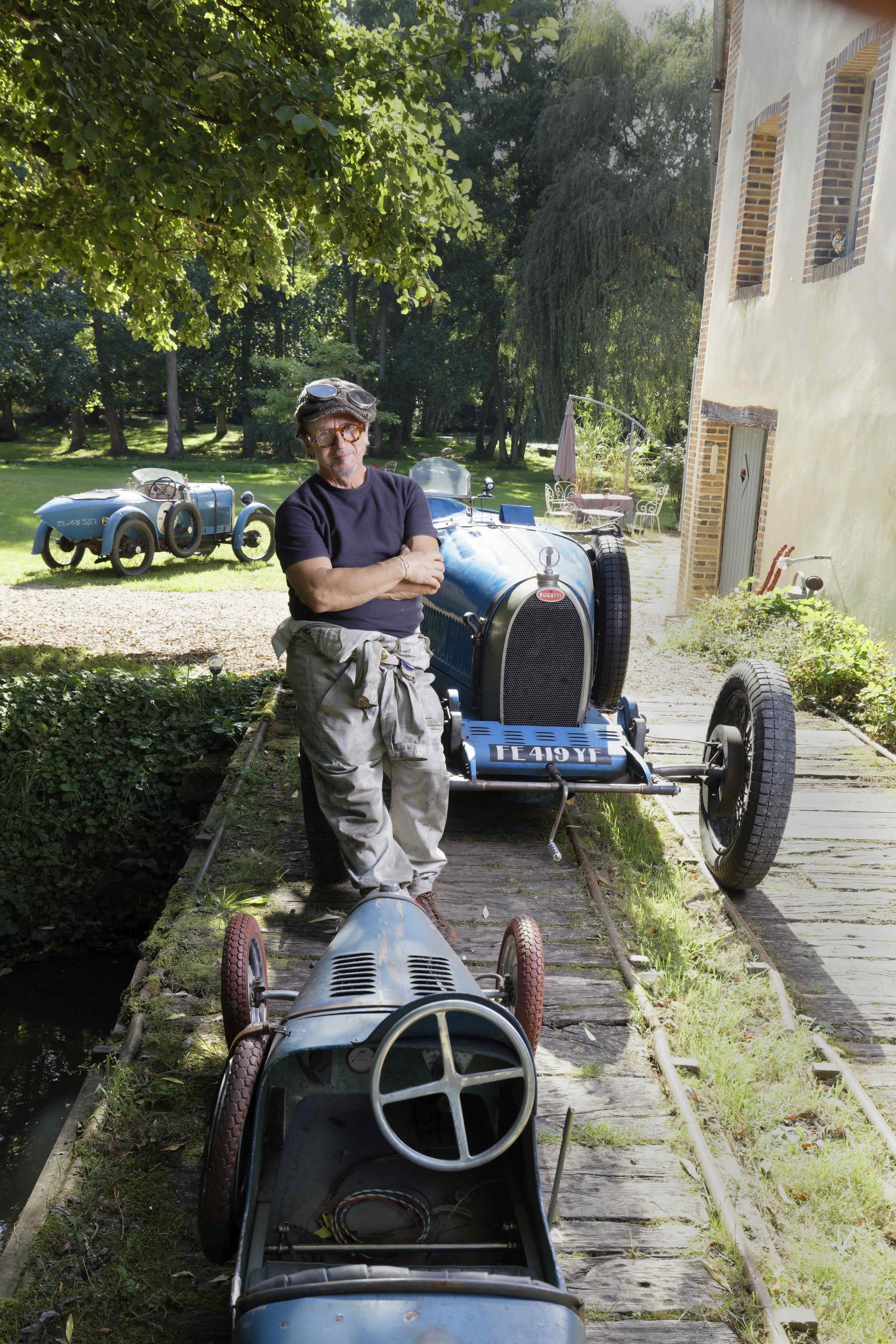
Jean-Pascal Viault, French Type 37 driver and well known kids’ car collector (www.voitureapedales.fr) is preparing an art book focusing on the Baby Bugatti (he owns the #445).
Published by the French editor "Odyssée", in 2 versions (French and English) Jean-Pascal and his crew are working on a book based on the most exhaustive world register they can gather.
If you own an authentic Baby Bugatti, please contact him if you want your car included.
Top Photo: J.P.Viault, by Bernard Canonne for Auto Heroes
Bring a Trailer Auction Online, USA, October 14, 2024
Bring a Trailer Auction Online, USA, October 4, 2024
Aguttes AUTOWORLD : Auction & motion auction, Brussel, Belgium, October 5, 2024
Bonhams' Auction, the Zoute Sale Knokke-Heist, Belgium, October 6, 2024
RM Sotheby's Hershey Auction Hershey, PA, USA, October 9 - 10, 2024
The Chantilly Arts & Elegance returned for 2024 in magnificent form. Blessed with sunny weather (albeit with a chilly morning), this magnificent concours d’elegance at the Château de Chantilly just outside Paris offered a diverse selection of classics cars and vintage delights, organised with a distinctive French flair. It was held on September 14-15.
Chantilly Arts & Elegance splits its concours winners into three: pre-war, post-war and concept. This year’s pre-war Best of Show winner was a 1928 Bugatti Type 35C (Chassis no. 4871) from the AV Collection. This was competing in the 100 years of Bugatti 35 class, which was dedicated to the late Peter Mullin. One of two Works cars sent to compete in the Targa Florio, it was bought by Janine Jennky, the partner of racer Albert Divo. She was an operatta and racer – she won several hillclimbs, and was also the victor at the 1928 Burgundy Grand Prix, setting the lap record at an average of 137km/h.
The winner of Chantilly Arts & Elegance Best of Show for post-war cars was an Antem-bodied, Jacques Saoutchik-designed 1949 Talbot-Lago T26 GS Coupé, while the 2023 Lancia Pu+Ra HPE won the prize for concept cars.
Bonhams' Auction, Goodwood Revival: Collectors' Motor Cars and Automobilia, September 7, 2024
The Indianapolis Motor Speedway Museum is undergoing a major renovation and is selling off some of its rare cars - an opportunity that could attract collectors from around the world.
The Indianapolis Motor Speedway Museum, founded in 1956, is considered a must-see destination by fans of the track. What started as a modest collection has grown into one of the most impressive museums of its kind. In order to attract even more visitors, the museum is currently undergoing renovations to present its collections in a more vibrant and interesting way for the general public. The makeover is estimated to cost $89 million and will include refurbishing the building as well as some of the cars on display. To finance the renovation, the museum has decided to auction off eleven vehicles through RM Sotheby’s.
One Bugatti will be sold: An original Type 35B, Chassis number 4947, engine 201.
This car was produced in October 1928 and must first have been raced by the factory. It was later raced by Georges Bouriano from Brussels, but not with much succes. In the late 1930's it was sold to Arthur Legat, a garage holder in Haine Saint Pierre close to the French border who called it La Boule II. He raced it at Chimay again 1935 and 1939 (# 20) and it became fourth at the Belgian Grand Prix in 1938 and again at Chimay in the first race after the war when it became fourth in 1946. It had the Belgian Record for the flying kilometer in its category in 1955. Through Jean de Dobbeleer it was sold to the USA in the 1950's. The museum has owned it since 1960.
Gooding & Company London Auction Hampton Court Palace, London, UK, August 30, 2024
PEBBLE BEACH, Calif. (August 18, 2024)
This year, 214 cars from 16 countries and 29 states pulled onto the competition field, and the car named Best of Show was a 1934 Bugatti Type 59 Sports presented by Fritz Burkard of The Pearl Collection in Zug, Switzerland.
Thrilled owner Fritz Burkard exclaimed, “I’m so happy for the car, so happy for Bugatti. This car is incredible. It’s so much history—one of the most successful Bugattis in history—and to win with this car means a lot to me. First time a Swiss, first time a European wins, first time a preservation wins. It’s important that preservation also gets recognition, because a car can only be once original. And it drives so beautifully.”
With this win, Bugatti and Mercedes-Benz are tied for the most Best of Show awards at Pebble Beach: ten wins each.
This year’s race for Best of Show featured other strong contenders, including the 1948 Talbot-Lago T26 Grand Sport Saoutchik Fastback Coupé presented by Robert Kudela of Chropyne in the Czech Republic; the 1934 Packard 1108 Twelve LeBaron Sport Phaeton presented by Harry Yeaggy of Cincinnati, Ohio; and, perhaps most surprisingly, the 1970 Lancia Stratos HF Zero Bertone Coupe, which was presented by Phillip Sarofim of Beverly Hills, California, in our history-making display of Wedge concepts and prototypes.
The competition got underway on Thursday when the majority of Concours entries participated in the 26th Pebble Beach Tour d’Elegance, which traces about 70 miles of scenic coastal roads. Entries that complete the Tour have the advantage if they tie in the Concours class competition.
The Pebble Beach Concours has already raised more than $3 million for charity this year, bringing the event’s total charitable donations to over $41 million to date. Through the Pebble Beach Company Foundation, the primary charitable partner of the Concours, these funds will benefit nearly 100 local nonprofits focused on youth education, impacting the lives of more than 10,000 children annually in Monterey County.
Apart from Best of show, there were a few more prizes for Bugattis:
BEST OF SHOW
1934 Bugatti Type 59 Sports
The Pearl Collection/Fritz Burkard, Zug, Switzerland
SPECIAL AWARDS
Center for Automotive Research at Stanford (CARS) Award for Automotive Innovation
The French Cup
CLASS AWARDS
J-2: European Classic Touring Late
L-1: Prewar Preservation
R: 1990s BPR & FIA GT Race Cars
RM Sotheby's Monterey Auction Monterey, CA, USA, August 15 - 17, 2024
Gooding & Company Pebble Beach Auctions Pebble Beach, CA, USA, August 16 - 17, 2024
57573-5
Here it is photographed with the Type 35 owned by Bugatti SAS, as well as the new Bugatti Tourbillon. From directly above the design can be clearly seen, from the side it is a bit more difficult. The T35 on the photographs is not an original T35, it started it's life as a T37, chassis # 37178. Parts of the frame of this car are from 37178. The engine
However, who knows where Bugatti took the inspiration for his cast-aluminium wheel? Some say it was from Miller, who actually patented a design for a car with (6-spoke) aluminium wheels. Wheels that were never actually made.
My guess is that it was during a walk through the center of Molsheim, at the Place de l'Hôtel de Ville, that Ettore took his inspiration for the design of his revolutionary wheel. The pillar on the old fountain there is decorated with a sculpture on top. Of course the quality of the stone has faded a bit over the past 101 years, but the 8-spoked wheel on the shield, held by a lyon and decorated with two angel's heads, can be clearly seen!
Below the text from Bugatti SAS:
A century ago, on August 3rd 1924, the Bugatti Type 35 was introduced to the world for the first time as five examples of Ettore Bugatti’s new racing car took to the starting grid at the Grand Prix de Lyon. With one held in reserve to showcase to the media, there was an immediate appreciation of the elegance and beauty of the Type 35, but no one could have imagined just how quickly, and how far, the legend of this lightweight Grand Prix racer would grow. Even 100 years later, it continues to inspire the direction of new Bugatti hyper sports car and Bugatti enthusiasts all over the world celebrate its impact.
The series of Grand Prix races between 1922 and 1925 was a period of great innovation in the automotive world, requiring cars to have engines of no more than 2 liters in capacity, weigh a minimum of 650kg and with a minimum width of 80cm, allowing for mandatory passenger mechanics. It did, in effect, drive the evolution of roadgoing sports cars, and required manufacturers to derive more power with new inventions in engine technology rather than simply increase capacity. Ettore Bugatti’s latest entry into this elite tier of motorsport was the Type 35.
The revolutionary cars made the road journey to Lyon without trouble but the race would turn out to be not quite as straightforward. However, the Type 35’s main issue during its debut race was caused by a component Bugatti had no control over: the vulcanized tires. Characteristic of Bugatti’s meticulous attention to detail, mechanical failures were rare, but a manufacturing defect within the tires caused many of the cars to retire, but not before one of them could secure a fastest lap of the whole race.
Achievements such as this exemplify how the iconic Bugatti model sparked a period of innovation in racing and road car design, as manufacturers hurried to develop faster cars, only for further ingenuity to emerge from Molsheim, including supercharged variants of the Type 35.
“The Type 35 is one of the all-time greats, not only as a racing car but also as a piece of design and engineering. This year alone, for the centenary year, we have seen Bugatti enthusiast clubs from around the world celebrating this legendary car and its debut at the Grand Prix de Lyon. And that isn’t because this is the site of one of the Type 35’s greatest victories, but in recognition of the fact that this was the moment that the world of motorsport changed; for the next five years the Type 35 would be almost unbeatable, as its inherently fast fundamentals evolved to become even more advanced and even more powerful.”
Luigi Galli, Bugatti Heritage and Certification specialist
Bonhams' Bugatti to Lalique auction -
The Mullin Collection, July 24, 2024
This auction, unique as it is to see so many Carlo and Rembrandt items in one sale, is most remarkable for one particular event: It marks the Recognition of Lidia Bugatti as an Artist in her own right.
Both a series of paintings as well as a sculpture of a horse went well over their estimates. In case of the paintings, this was even more than 40 times the maximum estimate, while the horse reached $150k (without premium), while the maximum estimate was just $9000!
Below all prices attained at the auction, family members are ordered with the youngest first, this time. Prices are including premium (28.5%). Images of all items can be found in the complete catalogue of the auction. Numbers at the beginning of each line are the lot numbers.
Lidia Bugatti
Rembrandt Bugatti
Ettore Bugatti
Carlo Bugatti
Bonhams' Goodwood Festival of speed auction, July 12, 2024
Bonhams' The Bonmont Sale, June 30, 2024, Cheserex, Switzerland
This extensive collection of Bugatti art items comes from the collection of Peter Mullin, who deceased September last year, aged 82. Most of these were shown at the "Art of Bugatti" Exhibition in Oxnard in 2014.
While most of the Car collection from Mullin has already been sold (Most in the Gooding & Co auction held on April 26, 2024), it was unsure if the art collection, encompassing not only Bugatti but also Lalique radiator mascots and some other art and furniture, would be sold privately or in a public auction. As it turns out now, it will be a public auction, where most, if not all, of the Bugatti Art will be sold. Estimates for all the items on auction can be found in the complete catalogue. Estimates range from around €1,000 for the drawings or paintings by Carlo, Rembrandt or Lidia, to over €200,000 for the most special Rembrandt Bugatti sculpture.
The Art Deco period was a brief era of art and design that was born in the 1910s and quickly
faded with the chaos and destruction of World War II. For some, it quickly flashes before our
eyes as we gaze at the Empire State or Chrysler buildings, but for Peter Mullin, Art Deco was
the supreme expression of artistry and industrial design during the 20th century. The Art Deco
movement is unique in that it bridged the gap between the handmade and factory produced,
between the warmth of ivory, gilt and mahogany and the polished coolness of rolled steel.
Mr. Mullin was fascinated with this transitional period in design history, and the collection he
built reflected not only his impeccable taste, but his discerning eye that only sought out the
best examples.
Peter Mullin - philanthropist, businessman, and collector - was known far and wide for having
the most impressive collection of pre-World War II Bugatti vehicles in the world. However, his
passion for the Bugatti design aesthetic and Art Deco movement was not limited to cars but
extended to the entire Bugatti family’s artistic output and to masterpieces of design from that
period. To that end, Peter and Merle Mullin amassed one of the most extensive collections
of Carlo Bugatti (father of Ettore Bugatti, celebrated car maker) furniture in the world, and
certainly the largest collection of the storied maker’s oeuvre to ever come to auction. Of
particular note is an extremely rare silver dragonfly bowl made towards the end of Carlo
Bugatti’s artistic career, perhaps the only one of its kind in existence. Solidifying the Mullins’
holdings were superlative examples of bronze animalier sculptures by Rembrandt Bugatti
(brother of Ettore) and Lidia Bugatti (Ettore’s daughter).
In addition to the impressive selection of works from the Bugatti family in their collection,
Mr. and Mrs. Mullin bought furniture by such historied makers as Jules Leleu and Maurice
Dufrêne, and sculpture by Maurice Guiraud-Rivière and Pierre Le Faguays. Magnificent in
its depth and breadth is a stunning grouping of molded glass car mascots by René Lalique
offered within this auction. Designed for a brief period between 1925 and 1931, these Art
Deco masterpieces were specifically produced for French automobiles prior to World War II,
bridging Peter Mullin’s interest in industrial and artistic design.
Focus of the auction is the Carlo Bugatti furniture, of which many examples will be sold, see the complete catalogue. However, Mullin had some rarer Carlo Bugatti items in his collection, one silverware "Dragonfly Bowl" from
circa 1907, see above and the top photo for a detail. Apart from that, three oil-on-canvas paintings: one of his daughter-in-law Barbara (married to Ettore Bugatti), one of his wife Thérèse, and one of a landscape. Also, one of the relatively rare stringed instruments.
Rembrandt Bugatti is a bit less prominent in the collection, with four sculptures like the one of the Crouching Jaguar above. More special is the one of the same Barbara Bugatti, his brother's wife (below left), and said to be the girl he loved all his life. Interesting also some relatively well-known drawings, plus a study of a man's Bust (below right).
Lidia Bugatti, 2nd daughter of Ettore Bugatti and Barbara Bolzoni, was not much recognized for her artistic work, before the exhibition in 2014 already mentioned, and an article in the Bugatti Revue. Of her, a couple of Bronze horses (above) will be auctioned, as well as a collection of 4 paintings. In these paintings, oil on paper and made from 1932 to 1956, the automobiles of her father Ettore play a prominent role.
Ettore Bugatti is not really the focus of this auction, however one of the items on auction is a 1927 "Baby" electric Bugatti, numbered 379A (Estimate: € 93.000 - € 120.000). Furthermore a trunk (Below) from an automobile, said to have been the property of Ettore, and a replica radiator mascot for the Bugatti Royale. The mascot of course was sculpted by his brother Rembrandt.
Auction details:
The official auction partner of the annual Concours of Elegance at Hampton Court Palace will offer for sale an early Bugatti Type 57 Atalante, a Bugatti Type 43A Roadster, and other selections from the Jaap (Jack) Braam Ruben Collection.
Global auction house and international market leader Gooding & Company is proud to return as the official auction partner of the Concours of Elegance at Hampton Court Palace later this summer, where it will host its annual London Auction on Friday, 30 August. Gooding & Company today announces a quartet of historic, significant classic Bugattis from the world-class collection of Jack Braam Ruben, based in Maastricht, The Netherlands. This grouping includes one of the earliest surviving examples of the Bugatti Type 57 Atalante, a remarkably well-preserved and patinated Bugatti Type 43A Roadster, an award-winning, unrestored Bugatti Type 57 Stelvio, and a show-quality Bugatti Type 57 Ventoux.
“Jack Braam Ruben is widely recognized in our industry as one of the foremost traders and collectors of classic and prewar cars in the world, and he has an especially keen sense for the most significant examples from the Bugatti and Alfa Romeo marque,” said Gooding & Company President and Co-Founder, David Gooding. “We are privileged and delighted to present these very original Bugattis from his premier collection at our London Auction, and look forward to offering these exceptional motor cars on the historic grounds of Hampton Court Palace.”
1935 Bugatti Type 57 Atalante (Estimate: £3,000,000 – £4,000,000)
Ordered new by Bugatti agent Monestier in Lyon for its first owner, Mr. Perrot, it was equipped with 18-inch wire wheels and Lockheed hydraulic brakes, per special customer request. 57252 would pass through a succession of French owners for the next two decades before being sold to famed Belgian Bugatti restorer and dealer Jean De Dobbeleer of Brussels in 1956. In 1957, the Atalante was exported to the US by Bugatti collector Lyman Greenlee. The car would eventually make its way back to Europe, first to Guido Artom in Italy, and then to Peter Rae in the UK. Mr. Rae correctly restored the car to its original specifications, including Scintilla headlamps and Lalique-style running lights mounted atop the fenders. 57252 remained in the UK before joining Mr. Braam Ruben’s collection in 2019. The Dutch collector commissioned a thorough restoration, tasking Bugatti specialist Classic Skills of Lomm, The Netherlands, with the work. The exterior was refinished in its original two-tone smoke and sage green color scheme, the interior was reupholstered, and the dashboard and bumpers were returned to their original configuration. Confirmed to still retain its original engine, no. 195, per documentation on file, this incredibly well-restored and historically important Type 57 Atalante, with its visually distinctive early design, presents a rare opportunity for any discerning Bugattiste and collector.
1933 Bugatti Type 43A Roadster (Estimate: £3,000,000 – £4,000,000)
Next, 43309 joined the collection of Manfred Dolleschel, who entered the Type 43A in the International Rally in the UK in 2004, and the International Rally in Tuscany in 2009. In more recent years, 43309 was exhibited at the Concours of Elegance at St. James’s Palace in 2013, as well as the 2022 Pebble Beach Concours d’Elegance® following completion of the Pebble Beach Motoring Classic. This Type 43A has a gorgeously patinated, two-tone gray finish, with subtle evidence of original black and yellow paint in small sections throughout the exterior. Retaining many important original components according to an accompanying report by marque authority Mark Morris, including its original semi-roller bearing crankshaft, much of its original leather upholstery, and original engine, stamped no. 106. In place of the standard wooden dashboard is a two-piece aluminum dashboard. It is beautifully constructed, shifting all of the gauges from the center of the dash to a panel surrounding the steering column, giving unrestricted access to the centrally-mounted magneto ignition. 43309 represents what is surely an unrepeatable opportunity for the discerning collector to acquire what is widely recognized as one of the best examples of the Type 43.
1935 Bugatti Type 57 Stelvio (Estimate: £900,000 – £1,100,000)
1938 Bugatti Type 57 Ventoux (Estimate: £550,000 – £650,000)
Auction details:
Catawiki Auction, June 30, 2024
Many details were already known, but there is (of course) more. More photograps also, these ones were almost all shot by me.
Unfortunately, Mate Rimac was not present, but I had some conversations with Christophe Piochon and Andy Wallace.
Highlights and details of the Bugatti Tourbillon:
Around the presentation of the Tourbillon, an entire exhibition of Bugatti's classic and new was presented. Some of the classic Bugatti's were brought by the vistors, which came from many different countries. Overview of this exhibition can be found here.
Below: Short movie of the appearance of the Tourbillon
Below: official Bugatti information on the Tourbillon.
THE BUGATTI TOURBILLON: AN AUTOMOTIVE ICON ‘POUR L’ÉTERNITÉ’
In 2004, the reborn Bugatti brand transformed the world of automotive performance and luxury with a 1,001 hp hyper sports car: the Veyron. The first road car with more than 1,000 hp was succeeded in 2016 by another engineering feat so ambitious it reset all expectations of performance, the world’s first 1,500 hp car: the Chiron. At the heart of these cars was the world’s most advanced automotive engine: an 8.0-liter quad-turbo W16. Now, 20 years after Bugatti invented the hyper sports car, it redefines the concept completely with an entirely new powertrain and platform. This is the Bugatti Tourbillon.
NAME AND PHILOSOPHY
Mate Rimac, CEO of Bugatti, said: The development of the Bugatti Tourbillon was guided at every step by the 115 years of Bugatti history and the words of Ettore Bugatti himself. His mantras ‘if comparable it is no longer Bugatti’ and ‘nothing is too beautiful’ were a guiding path for me personally, as well as the design and engineering teams looking to create the next exciting era in the Bugatti hyper sports car story.
“Icons like the Type 57SC Atlantic, renowned as the most beautiful car in the world, the Type 35, the most successful racing car ever, and the Type 41 Royale, one of the most ambitious luxury cars of all time, provide our three pillars of inspiration. Beauty, performance and luxury formed the blueprint for the Tourbillon; a car that was more elegant, more emotive and more luxurious than anything before it. Quite simply, incomparable. And just like those icons of the past, it wouldn’t be simply for the present, or even for the future, but Pour l’éternité – for eternity.”
As the first Bugatti in more than 20 years not powered by the iconic W16 engine, the tradition of naming core models after legendary Bugatti racing drivers of the past is no longer applied. Instead, the name Tourbillon was chosen as the perfect encapsulation of this car’s character. A French word, and a subtle reference to Bugatti’s French heritage and home in Molsheim, the tourbillon is a watchmaking invention of a Swiss-born genius living in France in 1801. A completely original creation without compare, it is both complex and beautiful, helping to counteract the effects of gravity on a watch to ensure more consistent time-keeping. And over 200 years later it is still revered as the pinnacle of watchmaking.
This sense of mechanical timelessness was a core part of the Bugatti Tourbillon journey. For a car that will be displayed on the concours lawns of this and the next centuries, technology can easily date – especially large digital screens – so it’s important that it uses as many timeless components as possible. The Tourbillon therefore utilizes a number of design and engineering techniques that will never age, including a completely analogue instrument cluster crafted by Swiss watchmakers and finished with the same care and attention you find in the world’s greatest timepieces. Just as these become heirlooms over generations, the Tourbillon is designed as a car for eternity.
DESIGN & AERODYNAMICS
Frank Heyl, Bugatti Director of Design, said: “The creations of Ettore and Jean Bugatti are ingenious in their aerodynamics, innovation and enduring beauty. We draw from the Bugatti Type 35, where the whole shape of the car was guided by the shape of the horseshoe grille, tapering back into this streamlined fuselage shape. We find inspiration in the Type 57SC Atlantic – the S stood for Surbaissé, which essentially meant lowered – bringing down the frontal area, lowering the roofline, lowering the driver and creating this wonderful stance and proportion. That’s something that was very important for us, carefully curating the placement of volumes that are both functional but also supporting the extreme proportions of the car. If the car is lower, it looks wider and the size of the wheels are emphasized; it looks like there is tension in the muscles, a posture ready to pounce. Every design decision is geared towards creating a sense of speed even at a standstill.
Using over 20 years of expertise from the Veyron and Chiron, the Tourbillon features a number of patented technologies. As a result, the rear wing even remains submerged during top speed runs, with a perfect equilibrium of forces generated by these new innovations. The wing is utilized to establish higher downforce at slower speeds and as an airbrake for improved stability under deceleration.
At the heart of the Tourbillon’s design ethos is the iconic horseshoe, from which all lines of the car originate, shaping the central fuselage volume. Docked onto that left and right are the flying fenders that allow to stream air underneath the headlights to boost air mass flow into the side intakes. This intricate interplay of airflow is further exemplified by the frontal design, which, while maintaining the dimensions of a sculpted overhang, ingeniously houses an ultra-efficient cooling system that directs air through and out of the front bonnet, augmenting downforce while ingeniously packaging a sizable frunk in between the two radiators.
INTERIOR
The centerpiece of this takes the horologie philosophy to its most literal conclusion; an instrument cluster designed and built with the expertise of Swiss watchmakers. Made up of more than 600 parts and constructed from titanium as well as gemstones such as sapphire and ruby, the skeletonized cluster is built to the largest tolerance of 50 microns, with the smallest at 5 microns, and weighs just 700g. This intricately engineered masterpiece remains a focal point of the driving experience, fixed in place as the rim of the steering wheel rotates around it – a set-up known as a fixed hub steering wheel. Through this ingenious concept Tourbillon drivers have an unobstructed view of their instrumentation independent of the steering angle because the spokes reach around the back of the instrument cluster
But hidden from view until desired is a high-definition digital screen, which displays vehicle data and offers seamless mobile connection. An intricately engineered mechanism deploys the touchscreen from the top of the center console; portrait mode for the reversing camera in just two seconds and full landscape mode in five seconds.
Every interior decision – just as it is with the exterior – is made with ultimate performance in mind, without compromising in any way on practicality or comfort. The seats, for example, are fixed to the floor to be as light and as low as they can possibly be, the pedal box can be electrically adjusted forwards and backwards to ensure a comfortable driving position for everyone. Thanks to this new solution, the interior is spacious, making it ideal for longer trips and daily use. Even the audio system is being engineered without traditional speakers and woofers, opting for an advanced system that features exciters on the door panels and throughout the car to use existing interior panels as speakers. It is a lighter and more efficient system than traditional audio set-ups.
POWERTRAIN AND PERFORMANCE
This next-generation Bugatti hyper sports car is powered by an all-new 8.3-liter naturally aspirated V16 engine – engineered with the help of Cosworth – paired with a front e-Axle with two electric motors and one electric motor mounted at the rear axle. In total, the Tourbillon produces 1,800 hp with 1,000 from the combustion engine itself and 800 hp from the electric motors. It’s an extraordinary achievement – delivered thanks to a host of cutting-edge materials and technology – given the Veyron achieved 1,001 hp from its 8.0-liter capacity engine with four turbochargers, and the new V16 is completely naturally aspirated. Constructed from lightweight materials, the engine weighs just 252 kg.
The electric motors are powered by a 25 kWh oil-cooled 800V battery housed in the central tunnel and behind the passengers. With four-wheel-drive and full torque-vectoring, it offers ultimate traction and agility. The front e-axle houses two electric motors, with a further motor on the rear axle, for a total of 800 hp from the electric powertrain system. The electric powertrain, with the electric motors spinning up to 24,000 RPM and a fully integrated dual silicon-carbide inverter, is amongst the most power-dense in the world. The e-axles are delivering over 6 kW per kg of e-axle mass, including inverters, motors and gearboxes. While power, throttle response and torque-fill are priorities for the electric powertrain, the relatively large energy content of 25 kWh allows for a very usable all-electric range of more than 60 km / 37 miles.
In the automotive industry, it is expected that each new model is heavier than its predecessor. Especially in case the new model adds a hybrid powertrain or more performance. But with a new Bugatti, the unexpected should be the norm. The Tourbillon boasts significantly improved performance, a very powerful electric powertrain system, a large battery pack and yet, it weighs less than the Chiron, which is a testament to the incredible engineering behind the Tourbillon. With its lightweight construction and instantaneous torque from the electric motors, the Bugatti Tourbillon delivers extraordinary performance.
Thanks to the combination of an extremely advanced hybrid powertrain and lightweight engineering, efficient packaging and advanced aerodynamics, the Tourbillon will be reducing significantly the emissions in comparison to its predecessor but still enhancing the driving experience and bringing to new levels the pinnacle of automotive industry.
Emilio Scervo, Bugatti CTO, said: “The Tourbillon had to be incomparable in every respect. Our philosophy has been to take any single aspect of Chiron and elevate it, looking for elegant and sophisticated engineering solutions and new technologies to deliver a timeless masterpiece. We wanted someone to be able to take any piece of this car, from inside, outside or under the skin, and believe that it could be placed in an art gallery. The result is a car which is beautiful inside and outside, the most powerful Bugatti to date which simultaneously elevates mechanical fascination and technical beauty to a whole new level.
The powertrain was perhaps the most important decision that we had to make, considering every option available to us; reengineering the W16, going fully electric or creating something entirely new. Ultimately, we chose the hardest possible option, creating a powertrain from scratch and pairing it seamlessly with a complex system of e-motors, a new generation eight-speed dual-clutch gearbox and more, all developed from the ground up specifically for the Tourbillon. But it was important to us that this car retained that pure and raw analogue feel of a naturally aspirated combustion engine, while pairing it with the agility and ability provided by electric motors.
We have already heard what it sounds like when this car reaches its 9,000rpm redline under full throttle, and it is a visceral, awe-inspiring experience that will echo for eternity. With the Tourbillon, we have engineered a car that delivers the best of combustion technology and electrification; free from compromises and built with a timeless dedication to creating a memorable driving experience.”
ENGINEERING
The completely new chassis integrates multi-link suspension front and rear, forged from aluminum, moving on from the double wishbone steel construction found in the Chiron. By opting for a new organic-designed suspension arm and upright, 3D-printed in aluminum, engineers have saved 45% in suspension weight compared with the Chiron. The rear also features an AI-developed 3D-printed hollow airfoil arm to enhance vehicle dynamics and aerodynamic performance.
Within the new chassis, the new ultra compact and lightweight front e-axle with dual independent motors, including the dual-inverter, fits within the same package space that was available in Chiron, adding more complexity without requiring more space. Designers and engineers also freed up more storage space and a larger luggage component, as part of the clean-sheet chassis and bodyshell design, allowing owners to fit a set of bespoke Bugatti Tourbillon luggage.
COMING IN 2026
“So yes, it is crazy to build a new V16 engine, to integrate with a new battery pack and electric motors and to have a real Swiss-made watchmaker instrument cluster and 3D-printed suspension parts and a Crystal Glass center console. But it is what Ettore would have done, and it is what makes a Bugatti incomparable and timeless. Without that kind of ambition, you might create a great hyper sports car, but you wouldn’t create an icon Pour l’éternité’.
Right: The author posing in front of the new Bugatti.
Today, the latest Bugatti has been presented, the Tourbillon (or Whirlwind), following up from the Mistral in it's name giving. With the Mistral, it shares it's wide frontal air intake. (not to call it a radiator)
The powertrain, a V16 engine together with 3 electric engines, gives out a total of 1800 horsepower.
The car, as is said, shares no components with any of it's predecessors, or any other car for that matter.
Apparently, only 250 examples will be made, at a cost of 3.6 million euro.
More details later.
Above, a small teaser of the new Bugatti (code name BR1, Bugatti-Rimac 1) which will be presented today at 10PM, local time (in Molsheim).
Bonhams' Impressionist & Modern Art Auction, Paris, June 5 2024
A new Bugatti era emerges: June 20, 2024
On the 20th June, a new era in the 115-year history of Bugatti begins. Guided by the vision of Ettore Bugatti, it will be an icon not just for the present, or even for the future, but ‘Pour l’éternité’ (for eternity).
The new Bugatti hyper sports car is a completely bespoke design, engineered from the ground-up on the three pillars of beauty, luxury and performance, inspired by Bugatti models of the past. The Type 57 SC Atlantic, the Type 41 Royale and the Type 35, respectively known as the most beautiful, the most luxurious and the most successful Grand Prix race car ever, each lend their DNA to create a pure and authentic reinterpretation of the Bugatti brand.
An all-new chassis and performance-honed body encompass an all-new V16 engine and electrified powertrain, representing a coming together of timeless mechanical craftsmanship and cutting-edge technology.
‘La Grand Première’ can be watched live on Bugatti social media channels on 20th June.
Bugatti is revolutionizing with providing private service stations and synthetic fuels for its hypercars.
Rimac believes that combustion engines still have a future, thanks to synthetic fuels that could replace fossil fuels. At a summit in London, he shared his vision of creating private Bugatti service stations using these fuels. This idea is linked to Porsche, which owns 45% of Bugatti Rimac and has been producing eFuel in Chile since 2022. Made from water and CO2 using wind power, eFuel would allow combustion engines to operate with an almost neutral carbon footprint. Porsche plans to produce 14.5 million gallons per year by the middle of the decade, with a goal of 145 million gallons by 2027. Although eFuel production is still limited compared to global needs, it represents a significant first step. The idea of ??using this fuel in Bugattis seems plausible, especially since these cars are produced in limited numbers and rarely driven. The next Bugatti hypercar is intended to be used beyond 2035, despite EU bans, thanks to synthetic fuels.
Since 2016, the Bugatti Chiron has remained an incomparable icon of hyper sports car performance. Limited to just 500 units, the final Chiron has now been hand-assembled by the craftspeople in Molsheim; a vibrant piece of bespoke art known as ‘L’Ultime’. This final farewell to Chiron marks the closing of an extraordinary era of performance that saw it become the first 1,500 PS roadgoing car as well as the first production car to surpass 300 mph. And just as it entered the world with spectacular elegance and power, so too does its production end, on the cusp of an all-new Bugatti era.
This final Chiron masterpiece – a Super Sport – beautifully reinterprets the car that took center stage in Geneva some eight years ago, exquisitely reminiscent in style and visual identity. When it first wowed the world back in 2016, the color split of ‘Atlantic Blue’ with ‘French Racing Blue’, intersected by a sweeping C-line milled from hand-polished aluminum alloy, was unlike anything seen in the automotive world before. For this 500th and final Chiron, the Bugatti Sur Mesure team reimagined the original design with a mesmerizing interplay of fading colors and a tribute to all the places where the car has spread its magic since 2016.
The aesthetic form of the Super Sport came to life when the Sur Mesure team at Bugatti and the customer decided to create an homage to this important moment in Bugatti’s history, retracing the most incredible milestones of the Chiron as well as celebrating the most important moments in the brand’s history, in-turn bringing to life the journey of the Chiron model, from its debut in 2016 to the present day.
This captivating legacy flows across the sides of the unique Super Sport in pure content composition: the launch in Geneva, appearances at Chantilly, testing phases at the Paul Ricard circuit and the 300 mph run at the Ehra-Lessien testing track. And, of course, the historic Bugatti home in Molsheim as well as the iconic Château Saint Jean and Cape Canaveral, where a number of customers have experienced the Chiron’s top speed performance.
Forming an unwavering bond to the wonderful artistry exhibited across the Super Sport is craftsmanship of the highest order, exquisite details that bring the Chiron’s eight-year timeline to life. The French flag, representing the birthplace of the brand and the car, is fittingly applied to the mirror wings. The Super Sport’s grille is finished in the brand’s now iconic ‘Atlantic Blue’ and a special horseshoe mesh has been crafted with centered stripes.
"The Bugatti brand is built not only on pure performance but on absolute craftsmanship, sophistication and elegance, forming the very pinnacle of the automotive sphere. This very special Super Sport – the final masterpiece in the era-defining Chiron family – embodies those values, sublimely connecting such incomparable core attributes with ease and purpose.
Christophe Piochon, President of Bugatti Automobiles
In every gleaming detail of the Chiron Super Sport masterpiece, Bugatti reaffirms its place as the paragon of automotive excellence, completing a circle with the Chiron hyper sports car family that commenced in 2016. The brand is now ready to write a new chapter of unmatched performance, luxury immersed in excellence, and tailored craftsmanship using the finest materials and the most extraordinary savoir-faire.
The interview is about the history of Bugatti, and how I got involved with this. There is so much that I could tell about Bugatti, that I really only touched upon the complete history.
Unfortunately, both the video as well as the Podcast are in DUTCH ONLY.
Bonhams' The Miami Auction, May 4 2024
May 25 - until October ??, 2024 Celebrating 100 years of T35 and the GP at
Lyon, August 3rd, 1924 - Exhibition at The Bugatti Trust Prescott, England
From The Bugatti Trust archive, the exhibition will include the earliest original sketch as drawn by Ettore Bugatti himself when he wrote to racing drivers Vincenc "Čeněk" Junek and his wife Elizabeth "Eliska" presenting his concept of the Type 35 racing Bugatti. Gifted by Elizabeth Junek to The Bugatti Trust founder Hugh G. Conway in 1968, it is the most important document of the ‘origin story’ of this famous model. The archive will also present what is believed to be the first blueprint for the Bugatti Type 35 and the original document will be on display.
We had the opportunity to set up this exposition in the episcopal building of the town and if you ever come you will be astonished by the location.
For the first time in France, Carlo, Rembrandt and Ettore will be displayed in the same place.
Everything on display will have a perfect provenance.
It was during a friendly lunch that Marc Stammegna, Adolphe Monticelli expert,
art dealer, enlightened connoisseur of bronzes by Rembrandt Bugatti, and François
Melcion, former director of Rétromobile, discuss their shared passion for
Bugatti family.
From this meeting emerges the idea of a tribute to the family trilogy.
Thanks to his 50 years of experience in the world of classic automobiles, which have
led to take charge of the “Rétromobile” show in Paris, François Melcion
was able to bring together a large number of emblematic vehicles.
For his part, Marc Stammegna is responsible for the presentation of a large selection
of works by Rembrandt Bugatti.
Finally, the fruit of joint work made it possible to bring together remarkable furniture
and exceptional pieces of silverwork by Carlo Bugatti.
CARLO BUGATTI (1856 Milan – 1940 Molsheim)
Very quickly, his artistic reputation asserted itself and his furniture adorned the most refined apartments of the European aristocracy.
Carlo intends to maintain a deep connection between the organic world of nature and his artistic technique. He uses the most varied materials to mix them into a unique piece of furniture, a true work of art.
His talent and genius are now recognized:
For his goldsmith pieces, he joined forces with the founder Hebrard whose technical genius allowed him to give free rein to his vision.
He settled permanently in France in 1904, in Paris, then in Pierrefonds, where he was Mayor, and finally in Molsheim where he joined his son Ettore and his grandson Jean.
ETTORE BUGATTI (1881 Milan – 1947 Neuilly s/Seine)
From a very young age, he designed mechanical parts and at the age of 14, he revealed his passion for mechanics.
From his time at the Brera Academy of Fine Arts in Milan, he retained a pronounced taste for aesthetics and simplicity, "the originality of the design is nothing without the perfection of the execution" and from 1898, he manufactured his first motorized tricycle.
In 1899, he manufactured a motorized quadricycle (the Type 1), then in 1900, he manufactured his first automobile, the Type 2, which won the grand prize at the Milan international automobile show.
After collaborating with Émile Mathis, then the German manufacturer Deutz, he finally founded his own brand in 1909 in Molsheim, then on German territory.
He will also build aircraft engines, boats and railcars powered by the 12.7 liter engine of the Bugatti Royale. In 1934, these railcars set a speed record of 192 km/h! The path to the TGV is all mapped out!!!
The golden age of the brand was in the 20s and 30s when Jean joined his father in the design office. Together they designed the Types 37, 40, 41, the famous “Royale”, the 43 which reached a speed of 170 km/h, then followed by the Types 44 which met with great commercial success and the 46 known as “little Royale”, the latest model. designed by Ettore.
The 55, designed by Jean, will leave its mark with its aesthetic, a timeless mark in the world of automobiles.
The following cars were designed by Jean, including the Type 57 and its derivatives.
Bugatti won the 24 hours of Le Mans twice: in 1937 with Robert Benoist and Jean-Pierre Wimille, at the wheel of a Type 57G, then in 1939, with Jean-Pierre Wimille and Pierre Veyron with a Type 57C.
The death of Jean, at the wheel of a racing Bugatti in 1939, began the decline of the brand and Ettore would never recover from this premature death.
During the war, the brand was “confiscated” by the Germans and disappeared despite the last battle of Ettore who succeeded in recovering the Molsheim factory at the liberation, but could never restart the activity due to lack of resources and customers.
In 37 years, the Bugatti brand will have produced nearly 7,500 luxury cars, filed nearly 1,000 patents, won more than 10,000 victories, including 2,000 for the Bugatti 35 alone (an unrivaled success to date) and established 37 records.
REMBRANDT BUGATTI (1884 Milan – 1916 Paris)
Self-taught, from his childhood he spent a lot of time in his father's workshop, immersing himself in techniques while letting his mind open.
At 16, he created a large “group of cows”, and three years later, in 1904, he signed an exclusive contract with Adrien Hebrard.
Exhibitions followed at the Société Nationale des Beaux-Arts, at the Louvre, and at the Salon d'Automne at the Grand Palais where he was placed next to Rodin who admired his work.
In 1904, Hébrard dedicated an exhibition to him in his gallery on rue Royale, which was renewed every year until 1913.
Unfortunately, after his suicide in 1916 and as a result of crises and wars, many of his bronzes were melted down in order to recover the metal. He will once again become the most sought-after animal sculptor in the world, from the 1970s, thus proving right.
Rodin when speaking to his students, he evoked Rembrandt Bugatti with these words: “Young people, here is your new master”
The animals sculpted by Rembrandt Bugatti are not imaginary but real animal portraits captured by the artist's subtle examination.
His bronzes placed under paintings by Van Dongen, Matisse, Derain and other masters are in full osmosis with the great Fauve artists.
In 1909, when he created the “Grand Anteater” or the “Baboin”, he created works close to Cubism, without even knowing Picasso.
The work of Rembrandt Bugatti is pure talent.
October 14, 2024 Bring a Trailer Auction
Online, USA
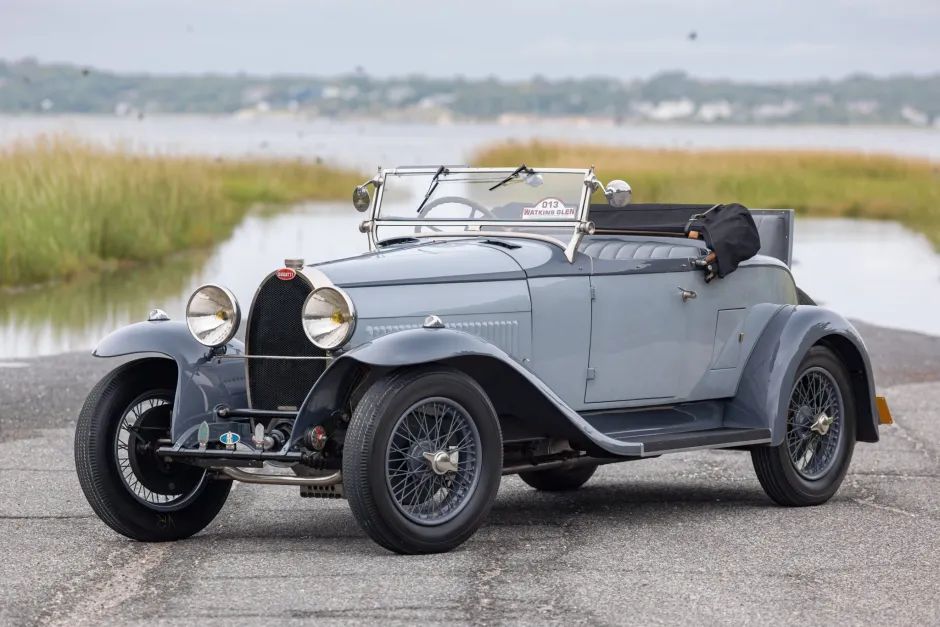
This 1930 Bugatti Type 40A is one of approximately 40 rumble-seat roadsters produced during a single model year and was purchased new by an owner in Paris. In 1937 it was sold to Parisian dealer Dominique Lamberjack, and by the 1950s it had been relocated to California, where it was acquired by collector Rudi van Daalen Wetters. The car remained with his family for several decades, during which a refurbishment was carried out in the mid-2000s at NostalgiCar in Korschenbroich, Germany. Work involved repainting the car in two-tone gray, retrimming the interior in color-keyed leather, and overhauling the cable-operated brakes. Following the seller’s purchase in 2016, the 1.6-liter inline-four was rebuilt, an alternator was added, and the exhaust system was replaced along with the clutch assembly for the four-speed manual transmission. Additional equipment includes a black soft top, a wood dashboard fascia, and 17” knock-off wire wheels. This Type 40A is now offered in New York with refurbishment documentation, two car covers, and a clean Montana title in the name of the seller’s LLC.
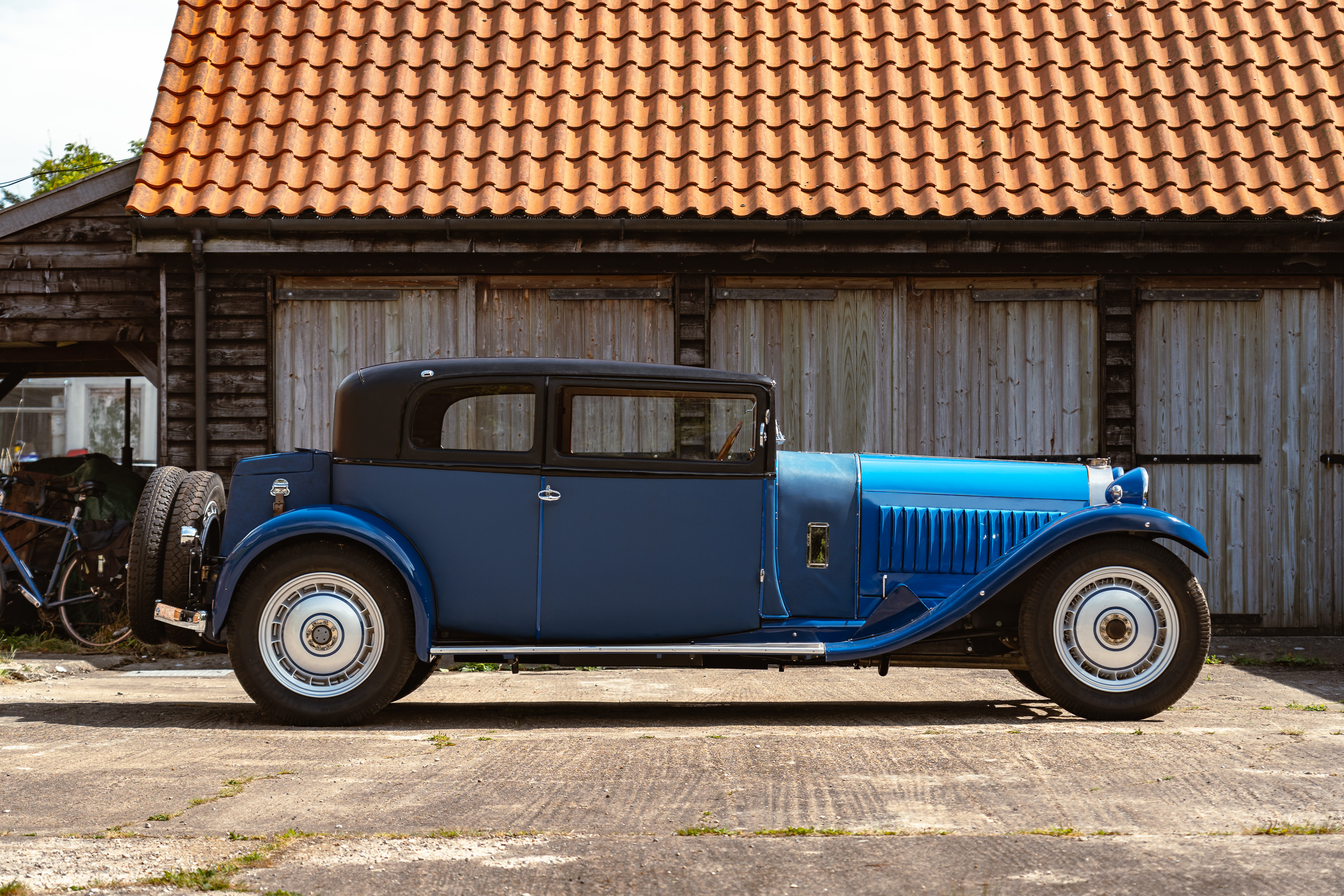
The Type 40 debuted in 1926 and was available in multiple configurations through various coachbuilders. The 40A roadster was offered only in 1930 and featured a design penned by Jean Bugatti, son of the company founder. Bodywork for this model was produced in-house at the Molsheim factory in Alsace.
Color-keyed 17” knock-off wire wheels are retained with two-eared spinners and are mounted with 475/500 Coker Classic tires. A matching spare is carried on the back of the car. The suspension features a front beam axle with longitudinal semi-elliptical leaf springs, a live rear axle with inverted quarter-elliptical leaf springs, and friction dampers all around. Braking is handled by cable-operated drum brakes at all four corners.
The four-spoke steering wheel has a wood rim, and a central bezel houses a Jaeger 160-km/h speedometer and 7k-rpm tachometer surrounded by a mixed set of supplementary gauges for fuel level, amperage, oil pressure, and coolant temperature. The five-digit odometer shows 42k kilometers (~26k miles), approximately 1,500 of which have been added under current ownership. Total mileage is unknown.
Power is sent to the rear wheels through a centrally mounted four-speed non-synchromesh manual transmission. An alternator has been retrofitted and is driven by a concentric pulley mounted to the driveshaft. The clutch assembly was replaced in 2022 at Sargent Metal Works of Bradford, Vermont.
German-language handwritten notes and illustrations created during the refurbishment are presented in the gallery and will accompany the car along with other service records, literature, and two car covers.
November 8 - 9, 2024 Exclusive Bugatti Seminar National Automuseum, Dietzhölztal, Germany
Participants will have exclusive access to the museum's Salle Bugatti, which is not open to the public, and will learn from recognized Bugatti experts how the myth of “Bugatti” has and will change from the past, through the present and into the future. And, they get the pleasure of experiencing up close one of the world's best Bugatti collections..
The experts will be: Achim Anscheidt, Julius Kruta and Professor Wolfgang Henseler.
And, Exclusive it is: There will be only 16 places available, at 2.750 Euro per participant!
During Prewar Days, enthusiasts, collectors, and historians gather to showcase and admire these vintage vehicles. It's an opportunity to see up close the exquisite detailing, craftsmanship, and engineering that define prewar automobiles.
I'm not 100% sure, but this may be the only event focusing on Prewar automobiles only!
December 6, 2024 - April 13, 2025 Bugatti: Reaching for Perfection Academy Art Museum, Easton, Maryland, USA
1) 1936 Bugatti Type 57 Atalante, Chassis no. 57456. Private Collection. Photo: Peter Harholdt
Online homeschool programs at Northgate Academy
Getting homework help online is easier than you think – check out myhomeworkdone.comBugatti News
October 14, 2024
October 14, 2024
October 10, 2024
 H & H Auction, Imperial War museum Duxford, Cambrigeshire, UK, October 9, 2024

September 19, 2024  More than 28,000 people came to the Chantilly Arts & Elegance. They enjoyed not just a varied selection of cars, but a chance to take in the latest machinery from McLaren, Bugatti, Alfa Romeo, Maserati and DS, while clubs from across France brought along their greatest exhibits to be shown in the grounds. A selection of historic McLaren racing cars was a joy to see, particularly Denny Hulme’s 1972 M8.
 Chantilly Arts & Elegance 2024 results
Class awards


September 9, 2024

September 4, 2024

August 31, 2024

August 19, 2024
For the first time in the history of the Pebble Beach Concours d’Elegance, Best of Show was awarded to a preservation car—a Bugatti Type 59. Concours Chairman Sandra Button noted, “This storied Bugatti, the first Type 59 built, is a rare factory race car that recorded multiple Grand Prix victories at the hands of several important racing greats—and it also has ties to royalty. Perhaps most importantly, it wears all of its history to this day, having been preserved in the livery it was given when redressed by King Leopold of Belgium.”
 Preservation cars have appeared on our show field for decades, and we have hosted formal classes for them since 2001.
1934 Bugatti Type 59 Sports,
The Pearl Collection/Fritz Burkard, Zug, Switzerland
1937 Bugatti Type 57SC Corsica Roadster,
John Rich, Gilberton, Pennsylvania
1st: 1938 Delage D8-120 Letourneur et Marchand Aérosport, Dana & Patti Mecum, Geneva Lake, Wisconsin
2nd: 1938 Bugatti Type 57C Gangloff Aravis, Gwen & Tom Price, Belvedere, California J-3: European Classic Sport
1st: 1933 Bugatti Type 55 Roadster (Chassis 55234), Robert Bishop, Palm Beach, Florida
1st: 1934 Bugatti Type 59 Sports, The Pearl Collection/Fritz Burkard, Zug, Switzerland
1st: 1996 Ferrari F40 GTE Michelotto, Jacob Brunsborg, Silkeborg, Denmark
2nd: 1995 Bugatti EB110 Sport Competizione, Chris Hrabalek, Berlin, Germany

August 18, 2024



August 11, 2024  As can be seen on the photographs above and right, Bugatti SAS built a special landscape detail next to the Atelier, on their grounds at Molsheim / Dorlisheim. It is a large Type 35 cast aluminium wheel, in grey bricks. Diameter seems to be about 35 meters.
  is a new Crosthwaite & Gardiner unit, as is the body. Rear and front axles are original, while the gearbox is an original, though from a Brescia.


 The Lyon-Givors race itself was globally renowned, and attracted more than 100,000 spectators, making it the ideal launchpad for Bugatti’s newest racing car. Over 500 miles and 35 laps, the races regularly lasted more than seven hours so to compete was not just to prove your speed but also to prove reliability. And as if seven hours of full throttle racing wasn’t enough of a test, Ettore Bugatti asked for the Type 35s to be driven from the factory in Molsheim to the race, on public roads, and back again – a journey of five hours each way even today.
 Testing within the intensity of a motor race such as the Grand Prix allowed Ettore Bugatti to identify the Type 35s weaknesses and improve them consistently; a formula which he continued to apply as the Type 35 evolved over its six years of production. During its active period, the beautifully proportioned, sublimely engineered racing car won some 2,500 victories across multiple disciplines, including road races, rallies, speed trials, and hill climbs. At the most demanding road competition of the age – the Targa Florio in Italy – the Bugatti Type 35’s star shone brightest and burnt longest, with five consecutive victories between 1925 and 1929, a record that stood right up until the last Targa Florio happened in 1977. It was such an astonishing motorsport achievement that it is celebrated to this day, with the International Bugatti Meeting 2024, hosted in Sicily in May, welcoming a number of historic Bugatti models to take part and celebrate the 100-year anniversary of the Type 35.


July 14, 2024
What stands out is the sale price for the bronze of his sister-in-law Barbara, which reached several times the maximum estimate. Also the drawings were sold at a lot more than the maximum estimate.
Etude de Buste d’Homme, circa 1900: Estimate: $1,000 - 1,500, Sold for $15,360
The baby was sold for a relatively low price, the trunk however seems to have been recognized for it's orignality.
Most of the Carlo Bugatti furniture was sold at least within their estimates, many even several times above that. Outstanding are the Desk (lot 36) and lots 51 and 52: an entrance arch and a pair of doors. The paintings of a landscape, Thérèse and Barbara were sold within their estimates.

Estimate: $15,000 - 20,000, Sold for $15,360
Estimate: $10,000 - 15,000, Sold for $16,640

July 14, 2024


July 11, 2024
 "The Mullin Automotive Museum has been created to honor the breathtaking
cars that grace its floors. Yet is my sincere hope that this museum will come to
be known not just for its automobiles, but for the homage it pays to the Art Deco
movement. Art Deco was an unstoppable artistic force all through the late 1920’s
and into the 1930’s, influencing sculpture, furniture, lighting, crystal, painting,
architecture, and many other forms of expression. It was a golden era of design…"
-Peter Mullin, Preface for The Art of Bugatti: Mullin Automotive Museum
"The Mullin Automotive Museum has been created to honor the breathtaking
cars that grace its floors. Yet is my sincere hope that this museum will come to
be known not just for its automobiles, but for the homage it pays to the Art Deco
movement. Art Deco was an unstoppable artistic force all through the late 1920’s
and into the 1930’s, influencing sculpture, furniture, lighting, crystal, painting,
architecture, and many other forms of expression. It was a golden era of design…"
-Peter Mullin, Preface for The Art of Bugatti: Mullin Automotive Museum


July 6, 2024
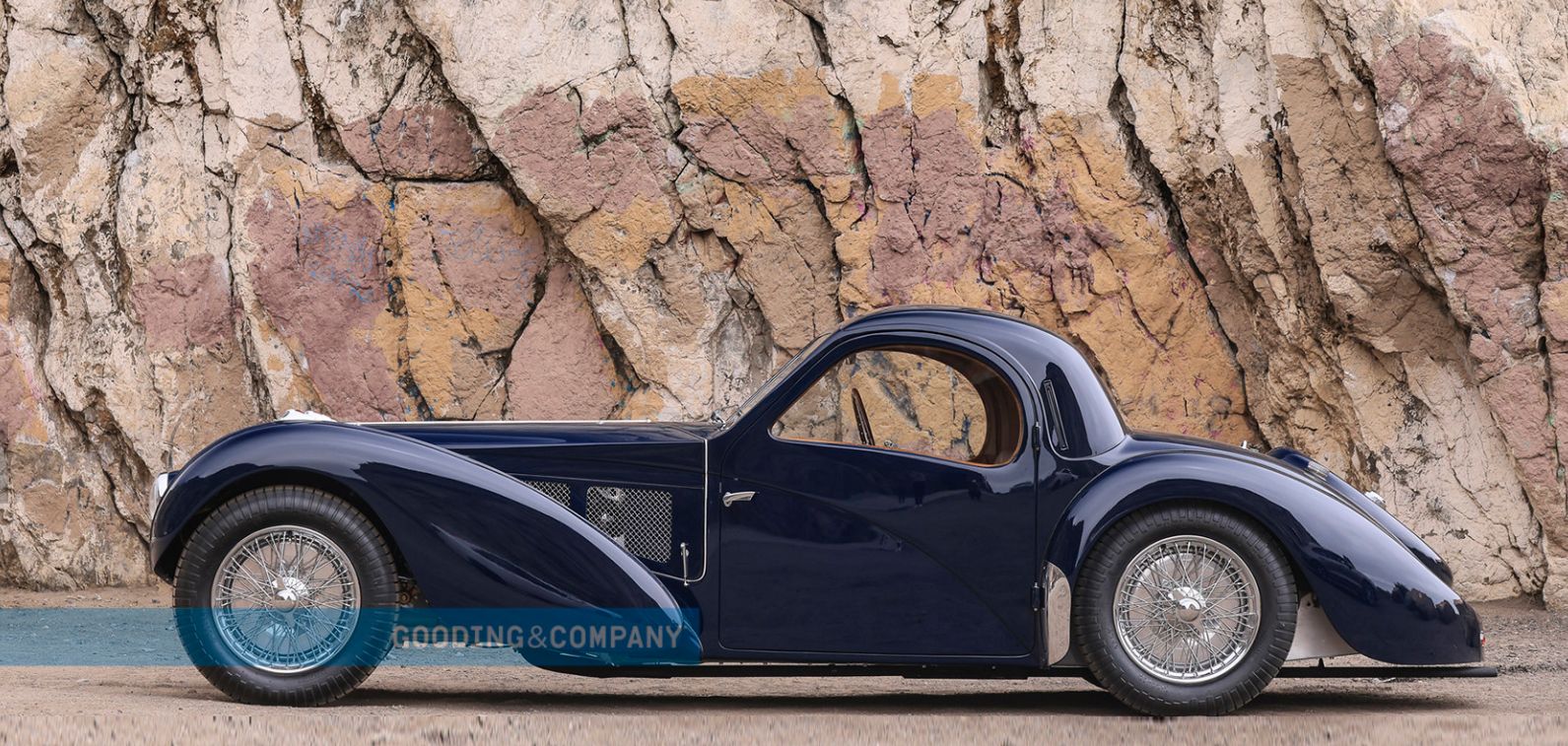
The Atalante is undoubtedly one of the most distinctive, attractive, and important styles of the venerable Bugatti Type 57. This example, chassis 57252, was built in November 1934 as a first series Grand Raid chassis, featuring a lowered steering column angle compared to a standard Type 57. Though originally intended to be clothed in Grand Raid roadster coachwork, the car was bodied by the factory in early 1935 with Jean Bugatti-designed Atalante coupe coachwork. This was the third such chassis to be equipped in this way. A mere 10 Atalantes would be produced throughout 1935; this very early example features a beautifully tapered tail section, which gives the entire car a lighter, more sporting design. This is achieved through convex wheel covers featuring special hand-formed tear drop shapes, as well as rear fenders which sweep up behind the wheel openings, resulting in the delicately tapered appearance not present on later Atalantes. Chassis 57252 was the third of these 10 Type 57s to receive Atalante coachwork, and of these, only three examples are known to survive today. 
The Type 43, and its successor, the Type 43A, were conceived as road-going counterparts to the Bugatti Type 35, the most successful and important of prewar Grand Prix racing cars. While a standard Type 43 was equipped with grand sporting coachwork, a 43A signified a car clothed in elegant Jean Bugatti-designed roadster coachwork. Mechanically, the 43A was equipped with a supercharged 2.3-litre inline eight-cylinder engine, based on the engine of the race-winning Type 35B. Bugatti built just 18 examples of the Type 43A, and of these, less than 10 are accounted for today. This Type 43A, chassis 43309, has the penultimate chassis number, and was delivered new to Edouard Michel of Paris in May 1934; it would remain in Europe for the next four decades. During this time, it was displayed at Serge Pozzoli’s famed Montlhéry Motor Museum, as well as the Le Mans Museum. Around 1978 the Bugatti was acquired by noted German Bugatti collector and historian Uwe Hucke. After nine years in Hucke’s ownership, it passed to Dr. Joachim Jantzen of Essen, who entered the car in a number of historic driving events. 
This Gangloff-bodied 1935 Bugatti Type 57 Stelvio cabriolet, chassis 57181, was equipped with engine no. 30 and fashioned with a light-colored soft-top hood upon completion. The car was sold new to France and was acquired after World War II by a Swiss owner, before being sold in the late 1960s to David Mize in the US in exceptionally original condition, having traveled only 27,000 km. An avid Bugattiste, Mize would later become the president of the American Bugatti Club. The Stelvio was later sold to collector John Risch, an American of Dutch origin, who won Best in Show with the car at the New Hope Automobile Show in Pennsylvania in 1968. Mr. Risch was the long-term owner of 57181, lovingly retaining it for several decades until his passing in 1991, after which point the car remained with his estate. In 2016, 57181 was displayed at the Pebble Beach Concours d’Elegance® in the Prewar Preservation class, where it was awarded Second in Class, and also completed the Tour d’Elegance. In 2018, the Stelvio was shown at the Amelia Island Concours d’Elegance before joining Mr. Braam Ruben’s esteemed collection in The Netherlands. Surely one of the finest unrestored examples extant, the Stelvio retains a wonderfully patinated original red leather interior, beautifully complimented by a subtle two-tone black and maroon paint scheme. 
Built on a Series III rolling chassis with engine no. 523 in October 1938, this Bugatti Type 57 Ventoux, chassis 57724, was completed near the end of the assembly line before the impending war brought production to a halt. Factory finished with a Gris Deauville (gray) body with Havane (tan) leather, the car was sold through British agent Colonel Sorel to its first owner, L.W. Young in 1940. It remained with Mr. Young for a decade before passing on to H. Archer-Smith, who reportedly won the Bugatti Owners’ Club Taylor Trophy with the Ventoux in 1958. In 1972, the Ventoux passed to John Frears, who displayed the car at the Stratford Motor Museum. In 1982, 57724 was acquired by Geoffrey Perfect of Penn in Buckinghamshire, a serious and respected Bugatti collector. It was during his ownership that the car captivated the attention of Mr. Braam Ruben, who would eventually add it to his collection in 2021. This exceptional, show-quality Type 57 Ventoux, with known provenance from new, has been displayed at some of the most prestigious events throughout its lifetime, including the Earls Court London Motor Show in 1989, Techno Classica Essen in 2019, and the Concours d’Elegance Paleis Soestdijk in 2022.

July 1, 2024

June 22, 2024 

The crowd anxiously waiting for the presentation to start, and Andy Wallace stepping out of the Tourbillon Today, I was present at the "enthusiast's presentation" in Molsheim. A flashy presentation with of course the Tourbillon on center stage.

 All this effort to only make 250 cars seems strange, considering all the development
work which has to be put into it. Maybe a follow-up will be introduced
relatively soon. In all, Bugatti now produced over 1000 cars, 450 of them Veyron's, 500 Chirons and over 50 specials like the Voiture Noire, Centodieci, Divo and more. The Mistral and Bolide are still being produced.
All this effort to only make 250 cars seems strange, considering all the development
work which has to be put into it. Maybe a follow-up will be introduced
relatively soon. In all, Bugatti now produced over 1000 cars, 450 of them Veyron's, 500 Chirons and over 50 specials like the Voiture Noire, Centodieci, Divo and more. The Mistral and Bolide are still being produced.


The "tent", venue for the presentation and the front of the Chateau St. Jean, with some of the classic Bugatti's on display.

As with every Bugatti of the modern era, the Tourbillon is ‘shaped by speed’. The ability to travel at more than 400 km/h requires every single surface, inlet and ridge to be finely honed to ensure it is not only aerodynamic but also beneficial to the car’s thermodynamics. This is the guiding principle of the Tourbillon, which is then evolved around four Bugatti design elements inspired by history: the horseshoe grille, the Bugatti Line, the central ridge and the dual color split. “Ever since Jean Bugatti began to apply bold dual-tone paintwork to his cars, it has become an important part of Bugatti design DNA, and in the Tourbillon, we evolve it once more in an authentic but modern way. That split happens around our fourth key design element: the Bugatti line, inspired by the color split lines of the Type 41 Royale and reborn as a core design element of both Veyron and Chiron. In-keeping with our new proportions, and lowered roofline, the Bugatti line now curves around more sharply, leaning forwards slightly as it winds its way around the roof, imbuing the side profile with a leaping motion.”
 Although beautiful in its design and proportions, every surface, intake and vent is carefully honed to balance the enormous aerodynamic forces of a car travelling at over 400 km/h as well as the thermodynamic requirements of a V16 engine, electric motors and battery at full performance.
 Much of this aerodynamic equilibrium is thanks to the new diffuser concept, which starts to climb from just behind the passenger cabin, rising at an ideal angle to keep the Tourbillon in perfect balance. The diffuser is built around a completely new crash concept, which is fully integrated within the structure of the diffuser itself, keeping it both enormously effective but also hidden from sight, enabling the open rear-end design.
 A set of advanced, electrically actuated dihedral doors not only allow for easy entry into the vehicle but provide a dramatic sense of arrival, able to be opened and closed from the key fob, the door opening button found just underneath the Bugatti Line and on the center console.
Ever since car manufacturers began to embrace digital screens and touchscreens in cars, the rate of progress has been so rapid that within less than a decade, the technology appears outdated. Imagining the Tourbillon on concours d’elegance lawns not just in 10 years but perhaps in 100 years, the design philosophy of the interior focused on timelessness. Inspired by the world of horologie, in which wristwatches over 100 years old can still be worn and used today, integrated into modern fashion and lifestyles seamlessly, the design and engineering teams pioneered an authentic analogue experience in the cabin.


 Christophe Piochon, President of Bugatti, said: “As well as the spectacular analogue innovations that have gone into creating a timeless interior such as this, we focused on authenticity of materials and perfection in every part. Informally we say that ‘what you see is what you get’, describing the fact that if you see a piece of what you think is titanium, then that’s what it is. Or if you see carbon fiber, or leather, then it will be exactly that – and always the best possible. With the Tourbillon, we are taking this impeccable authenticity and craftsmanship to the next level. Our completely new Bugatti platform has been designed in every single detail to express the pursuit of engineering excellence. It is clear from looking at any of Ettore Bugatti’s creations that every component – even if it is never seen – is a work of art, and that was our intention with Tourbillon, too. It is stunning in every detail, recognizably Bugatti and also a masterpiece of packaging and engineering.”
The Bugatti W16 engine was unlike any other automotive engine in the world when it was revealed. With its four turbos and prodigious power figures, it set a new benchmark for the limits of combustion engine technology, and two decades after its creation it’s still unmatched or replicated. Following in its footsteps is another incomparable masterpiece of internal combustion engineering, paired with the immediate torque and flexibility of electric motors.


 The Tourbillon is designed around entirely new chassis and body structure. The structure is made from a next-generation T800 carbon composite, which incorporates a number of weight-saving innovations, such as integrating the battery as a structural part of the monocoque and an unprecedented crash composite rear diffuser, inspired by top level motorsport. The front composite airducts that flow through the front of the car are also integral to the structure, ensuring that each and every part of the rigid, lightweight structure is optimized. For example, the front and rear frames exhibit low pressure thin wall aluminum casting and 3D printed structural braces, contributing to a structure that is significantly lighter and stiffer than its predecessor!
 The brakes are equally advanced, featuring the ultimate carboceramic technology. A bespoke brake-by-wire system is introduced, fully integrated with the moveable pedal box, and blended seamlessly through an integrated vehicle non-linear controller developed by Bugatti to the hybrid powertrain. Michelin Pilot Cup Sport 2 tires – 285/35 R20 at the front and 345/30 R21 at the rear – are a bespoke development for the Tourbillon.
Mate Rimac, Bugatti CEO, said: “We look back through Bugatti history at the creations of Ettore and Jean and you can immediately see that they refused to compromise. The amount of patents Ettore had to his name was incredible, because he didn’t ever want the simplest solution, he always wanted the best solution, even if it didn’t exist yet. He’d go away and he’d build it, test it and refine it until it was perfect. And then he’d make it beautiful. It is why the cars are so revered today, and it is the driving force behind everything we have done with Tourbillon. The Bugatti Tourbillon now enters its testing phase, with prototypes already on the road in anticipation for customer deliveries in 2026. A total of 250 examples will be built, with a starting price of 3.8m EUR net. Hand-assembly will take place at the Bugatti Atelier in Molsheim, following the final W16-powered Bugatti models, Bolide and W16 Mistral.
The Tourbillon and it's predecessors.

June 20, 2024
Above the complete presentation from June 20
June 20, 2024

June 10, 2024  Bassenge Auction "Gemälde Alter und Neuerer Meister" Berlin, May 30, 2024

June 7, 2024  Mate Rimac (Left), CEO of Bugatti Rimac, plans to provide a private gas station with every Bugatti purchased, using synthetic fuels. This concept could make refueling at home easier for owners of these hypercars.

May 30, 2024  "L’ULTIME'": Celebrating the end of the Incomparable Chiron Era
 Symbolizing the brand’s prowess and the evolution of it's craft and savoir-faire in the past eight years, the two colors that adorn this special Super Sport – a distinctively created fading ‘French Racing Blue’ and an ‘Atlantic Blue’ – now seamlessly blend with each other, merging to create an arresting side-on visual that is accentuated by the colored wheels mirroring the front and rear shades. A tailored blue Bugatti macaron, exclusively designed and developed for this farewell edition, sits proudly within the grille. In a spectacular flourish, adorning its bodywork are hand-written places and events that helped to build the legend of the Chiron. Inspired by the philosophy of 'bullet speed' – a blurring of vision at high speeds – this unique Chiron Super Sport² hints at its incomparable top speed, even at a standstill.
 Since its breathtaking global debut in Geneva eight years ago – revealed as the most powerful, fastest and luxurious car in the world – the Chiron has withstood the test of time, remaining at the pinnacle of automotive craftsmanship and performance. Channeling the DNA of Bugatti and encapsulating the brand’s ‘Form Follows Performance’ ethos, the Chiron has pushed boundaries, set benchmarks that were previously unimaginable and re-written so-called automotive norms across a critically-acclaimed family line-up that includes the Chiron, Chiron Sport, Chiron Pur Sport and Chiron Super Sport in additon to special editions like the Chiron Super Sport 300+ and Les Légendes du Ciel.

 Celebrating the very last Chiron, the hand-written number '500' – gracing the exterior, the wheel caps and rear wing – is also engraved onto the engine cover housing the magnificent Bugatti W16 powertrain. Simultaneously, it marks another milestone in the Bugatti journey of more than 115 years; another 500 incomparable works of art, inspired by Ettore Bugatti’s original vision, in the world to be enjoyed for generations to come.
 The use of the '500' seamlessly transitions from the outside to within, adorning a Chiron cabin that matches the bespoke nature of the car’s exterior. Here, a carbon fiber symphony unfolds for both the driver and passenger connecting the luxurious 'Deep Blue' leather and 'Blue Carbon Matt' high-tech finishes with hints of the iconic Bugatti 'French Racing Blue' shade. Intricate, hand-woven 'Deep Blue' leather that is hand-cut, hand-stitched and applied to each door panel offers this final Chiron the quintessence of excellence and timelessness, symbolizing peerless craftsmanship since the Chiron's unveiling in 2016.
 With this bespoke work of art, we have retraced the Chiron’s majestic eight-year journey with unforgettable moments that have taken place throughout the world, creating legions of fans for the Chiron, not to mention its countless industry-first breakthroughs and unique world-first achievements. This 500th and final Chiron model is a fitting farewell that captures a defining legacy that will forever be etched in automotive history and paves the way to a bright new chapter, starting with the production of the Bolide and the W16 Mistral and continuing with the unveiling of our new model in June."

May 26, 2024  A local newschannel invited me for an interview (see above), and a Podcast (Goto: open.spotify.com/episode/0s6nAKlVTrvpOuPpkaNqxN).

May 18, 2024 

 Bring a Trailer Auctions, USA, May 10 / May 17 2024
Bugatti news, former issues

The Bugatti Trust Museum and Study Centre, Prescott, England, is delighted to announce that its 2024 exhibition will be dedicated to the celebration of the centenary of the birth of the Grand Prix Bugatti. Opening on May 25th, the exhibition will focus on the Bugatti Type 35 as first presented by Ettore Bugatti to the international motoring community in August 1924 for the Grands Prix de l’Automobile Club de France weekend held in Lyon, France.  The star of the exhibition will be one of the surviving Type 35 Bugattis from the Grand Prix d’Europe race held on August 3rd one hundred years ago. On loan from The National Motor Museum, Beaulieu, this very special Bugatti was raced by Ernest Friderich as car number 13 (on the right, chassis #4328) at the time and a detailed history will be presented with the car for the exhibition. It will be on display to the public at the Trust until October 2024 with additional exhibits and curated educational material to document this extraordinary moment in motoring history.
June 22 - October 13, 2024 Bugatti Exposition "Une Dynastie de créateurs"
Uzes, France
 This Bugatti exposition, organized by François Melcion - who used to organize Retromobile, is in a small town called Uzes (located in the south of France at 40 kms from Avignon) which is a fantastic medieval town.
 He inherited the gifts of his father Giovanni, who was a renowned sculptor and architect in Italy and Europe.
In 1880, he began his career as a cabinetmaker by offering his first work to his sister, on the occasion of her marriage to Segantini, an Italian symbolist painter.
He inherited the gifts of his father Giovanni, who was a renowned sculptor and architect in Italy and Europe.
In 1880, he began his career as a cabinetmaker by offering his first work to his sister, on the occasion of her marriage to Segantini, an Italian symbolist painter.
1888: honorary diploma from the Italian exhibition at Earl’s Court in London,
1900: silver medal at the Paris Universal Exhibition.
At the height of his career, in 1902 Carlo obtained the honorary diploma from the 1st international exhibition of modern art in Turin where he exhibited four rooms including the one considered his masterpiece: “the snail room”.
This exhibition is the starting point for art nouveau in Italy.
To the Queen of Italy, who describes his creations as “Moorish style”, he responds “you are wrong, Majesty, this style is mine”.
 Ettore raised the automobile to the rank of Fine Arts, making him a pioneer and Bugatti a myth of the luxury, sports and competition automobile industry.
 In just 15 years, from 1900 to 1915, Rembrandt Bugatti, thanks to his innovative approach coupled with his exceptional genius, opened an impressionist door to the art of sculpture.
Thanks to his meeting with Adrien Hébrard, founder, magician of patinas and Palazzolo, goldsmith and trimmer, Rembrandt's bronzes are light and alive, with eternal beauty.

 The body was removed from the frame during the aforementioned refurbishment, and wood panels were replaced and other repairs were made before the car was repainted in two-tone gray. Exterior details include a black soft top, a louvered hood, a folding windscreen, and dual cowl vents. A door on the left quarter panel provides access to the rumble seat footwell. A Lamberjack Automobiles plaque is mounted on the right side of the cowl, and other badges are attached to the front crossbar. Paint chips, cracks, and blemishes around the car are shown up close in the gallery along with wear on the running board coverings.
 The right-hand-drive cabin features a bench seat trimmed in gray leather with color-coordinated door panels, each of which features decorative stitching, dual pocket flaps, and polished levers. Additional appointments include a wood dashboard fascia, a floor shifter, and black carpets. RJS latch-and-link harnesses show a December 2019 expiration date.
 The 1.6-liter inline-four features five main bearings as well as an overhead camshaft operating two intake valves and one exhaust valve for each cylinder. Induction is through a single Solex carburetor, and tubes built into the bottom of the crankcase channel air to cool the oil, which is pressure-fed. A rebuild in 2017 at High Mountain Classics in Greeley, Colorado, involved repairing a crack in the engine block and replacing the pistons. The engine was designed to use dual spark plugs, although it is currently set up for single-plug ignition. The radiator is cooled by an electric puller fan, and a coolant overflow tank was added under current ownership. The exhaust system was replaced in 2022.

Experience a unique journey with exclusive insights into the world of Bugatti and embark into a stylistic travel through time in an authentic Bugatti ambience. From the fascinating beginnings of the brand, to the artistic expressions, to the current successor of the Bugatti Chiron, as well as the future of designing a Bugatti with the help of artificial intelligence.
December 6 - 8, 2024 Prewardays Kortrijk, Belgium
 "Prewar Days" is an event that celebrates the golden era of motoring, focusing on vehicles that were manufactured before World War II. This period, roughly from the early 20th century up until the early 1940s, is considered by many enthusiasts as a time of significant innovation and craftsmanship in the automotive industry. Cars from this era are admired for their unique design, engineering marvels, and the historical context in which they were created.

Featuring loans from two important private family collections never-before seen together, along with pieces from the Museum of Fine Arts, Houston, and the Virginia Museum of Fine Art, this bijoux exhibition of cars, sculpture, and furniture will illuminate the multigenerational ambition and creativity of the Bugatti family and their place in the history of art, design, and cultural modernity. Among the highlights are eight bronze sculptures from the Arsidi-Scuderi Collection of Lugano, Switzerland, and five rare Bugatti cars from the North Collection: two grand prix race cars, two Type 57 touring cars, and a miniature "Baby." 


The exhibition will explore the rich artistic and technological legacies of the peripatetic Bugatti family, beginning with patriarch Carlo Bugatti (1856-1940). His fin-de-siècle furniture designs, which debuted at international expositions in London, Paris, Milan, and Turin, are noteworthy for their fanciful combination of materials: ebonized wood inlaid with copper, brass, ivory, mother-of-pearl, and vellum, which he often decorated with leather tassels, geometric marquetry, and painted designs. Sons Ettore (1881-1947) and Rembrandt (1884-1916) inherited their father’s artistic passion but pursued different paths. Rembrandt had a tragically brief career as a sculptor, producing deeply empathetic and impressionistic portraits of animals. Ettore, meanwhile, became a celebrated automobile designer and manufacturer. Although he famously declared, “Perfection is never reached,” he pursued it throughout his career. The cars that he and his elder son, Jean (1909-1939), designed came to epitomize the speed and dynamism of modernity. But the cars were much more than machines. As automotive scholar and guest curator Ken Gross has observed, "Everything about Bugatti was artistic: the cars, their advertising, and the enduring joie de vivre associated with the marque."


Visitors to the exhibition will be able to immerse themselves in the Bugatti family story as they view the furniture, cars, sculptures, photographs, advertisements, and other ephemera. These pieces and the stories behind them will provide a deeper understanding of the family's creative passions, their pursuit of perfection, and their place within the history of cultural modernity. “Although Ettore Bugatti famously declared, ‘Perfection is never reached,’ he obsessively pursued it throughout his career,” said senior curator Lee Glazer. 

The exhibition supports the museum’s commitment to education, outreach, and inspiration for all. With no admission fee, Bugatti: Reaching for Perfection will be accessible not only to car enthusiasts and collectors, but to art and design lovers, and the broader community, including students and residents of the mid-Atlantic region and the Eastern Shore.
2) Rembrandt Bugatti, Leaping Kangaroo, 1907. Arsidi Scuderi Colleciton. Photo: Peter Harholdt.
3) Carlo Bugatti, Hall Bench, c. 1890s. Wood, parchment, copper, brass, paint, leather. Virginia Museum of Fine Arts. Gift of Lloyd and Barbara Macklowe. 89.141. Photo: Troy Wilkinson. © Virginia Museum of Fine Arts.
Bugatti events from the past
Please let me know if you know the dates of any Bugatti events in the future.
I can be reached by email at J.J.Horst@BugattiPage.com.